The Myth That a Rule Is Just a Referee’s Call
See how a sports rule shapes choices before a referee intervenes, from keeping the ball in play to timing a run and responding to an advantage.
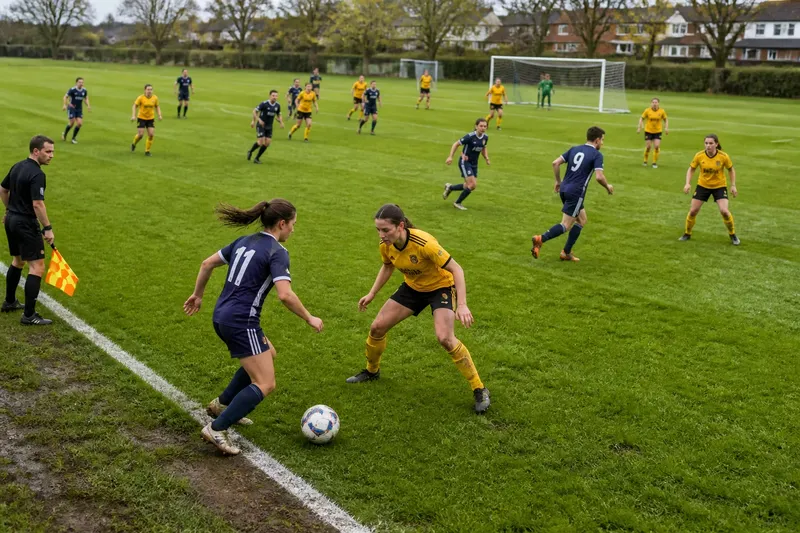
On a damp Saturday, a football winger slows as a pass rolls towards the touchline. She glances at the defender closing in and keeps the ball moving, acting on the expectation that play continues until the whole ball crosses the line. A sports rule shapes that choice before any referee raises a flag.
Rules do more than settle disputes. They give players a shared basis for deciding what to attempt, what to avoid and how to react while the ball is live.
Rules before whistles
Imagine a local fixture between Northfield and Vale. Early in the second half, Northfield’s winger, Mina, receives a pass near the touchline with a defender close by. The ball is still on the field, so she turns inwards and passes rather than stopping to appeal.
Vale’s defender makes the same calculation: a ball touching the line is still in play, so he challenges instead of picking it up. The referee says nothing, but the players’ shared understanding keeps the move going.
That silence is not an absence of rules. It is what their influence looks like when players make choices within the same expectations.
Timing an attack
Northfield’s teammate passes towards Rowan, who is near Vale’s last defender. Rowan checks his run. He knows that offside is assessed when a teammate plays or touches the ball, but position alone does not make an offence: the player must also become involved in active play in a way covered by the rule.
In general, a player is in an offside position if part of the head, body or feet is in the opponents’ half and nearer to the opponents’ goal line than both the ball and the second-last opponent. Arms and hands do not count. A player level with the second-last opponent or level with the last two opponents is not in an offside position.
Northfield’s midfielder can wait for Rowan to move back, pass to another runner or choose a different route. Vale’s defenders also decide whether to track Rowan or hold their line. The rule shapes those choices before an official needs to make a decision.
Say the midfielder passes while Rowan is in an offside position and Rowan then challenges an opponent for the ball. In that invented situation, the observable result would be an offside offence and an indirect free kick to Vale; the assistant referee may signal, but the referee makes the decision.
Judgement and involvement
Now imagine Rowan stays in an offside position but does not challenge for the ball or obstruct an opponent. His position alone does not make him guilty of an offence. If he later becomes involved in active play, the officials assess what he did under the offside rule.
This is why it helps to separate three things: the player’s position when the ball is played, what the player does afterwards, and the official’s judgement about whether that action meets the rule’s criteria. A close decision can require judgement without being a matter of personal preference.
After a call, players may adjust their tactics. Northfield could time Rowan’s run differently; Vale could track him more closely. Those responses reflect how the rule applies, not a rule that exists only when the whistle sounds.
Allowing advantage
Later, Northfield’s midfielder is fouled as he passes to Mina. He stays on his feet, keeps possession and sends a useful ball into space. The referee sees the contact and allows play to continue because Northfield may benefit from the attack.
The players must read the moment rather than assume that contact means an immediate whistle. Mina chases the pass, the fouled midfielder regains his balance and Vale’s defenders turn towards their goal.
If the expected advantage does not develop, the referee may stop play and return to the original offence, subject to the laws of the game. If the attack continues, the players have gained from playing on. Either way, their actions after contact matter.
Preparing a restart
Northfield’s attack ends when the ball crosses the goal line after a Vale defender last touches it. The referee awards a corner. The boundary rule now determines which team restarts and where the ball returns to play.
Northfield chooses a delivery and places players to challenge for it; Vale organises defenders to contest the likely route. The ball must be placed in the corner area, and opponents must respect the required distance. Those expectations shape positioning before the kick.
Imagine Mina sees a defender too close and asks the referee to manage the distance. The official can address the matter before the kick; Mina’s request relies on a shared restart rule, not a private bargain.
Responding to a disputed call
After the corner, a Vale defender clears the ball and a Northfield forward appeals for handball. The referee signals play on. Northfield’s players need to keep chasing or retreating to defend; an appeal does not itself stop play.
Imagine a Northfield defender grabs the ball after hearing a teammate shout “handball”, while the referee has not stopped play. The clear observable consequence is that the defender has handled a live ball; the safer decision would have been to continue playing and leave the call to the official.
Players can disagree with a ruling, but that does not change the immediate state of play. The rule supplies the standard, the events supply the facts, and the referee applies the standard to those events.
What do close calls reveal?
Does a rule exist before the whistle?
Yes. Players use rules to anticipate what is allowed and choose their actions, even when no official signals. A whistle announces an intervention; it does not create the shared expectation from nothing.
Can a player be offside by position alone?
No. Offside position is only one part of the decision. The player must become involved in active play in a way defined by the law before an offside offence is given.
Why might a referee allow play after a foul?
The referee may allow advantage when continuing is more beneficial to the fouled team than stopping play. If the advantage does not develop, the referee may return to the original offence under the applicable law.
What should a spectator watch?
Watch choices made before the signal: a runner checking a run, a defender holding position or a player continuing after contact. These actions show how rules shape play without an immediate decision.
Shared expectations at work
Northfield’s corner produces no goal. Vale clears the ball and wins a throw-in near halfway. The referee points in Vale’s direction, and both teams turn to the next task.
The match has moved through several rules without a whistle at every stage: the ball stayed in, Rowan timed his run, the referee allowed advantage and the teams organised for a restart. When a call arrived, it settled one moment within a system that had already guided their decisions.
To understand a close decision, watch what the players were trying to do before the official acted. A sports rule often begins shaping the match in that earlier choice.