A First Visit to a Community Match: Follow the Game Without Knowing Every Rule
Follow a community match without knowing every rule: choose one team, watch its shape and pauses, and leave with a clearer sense of the play.
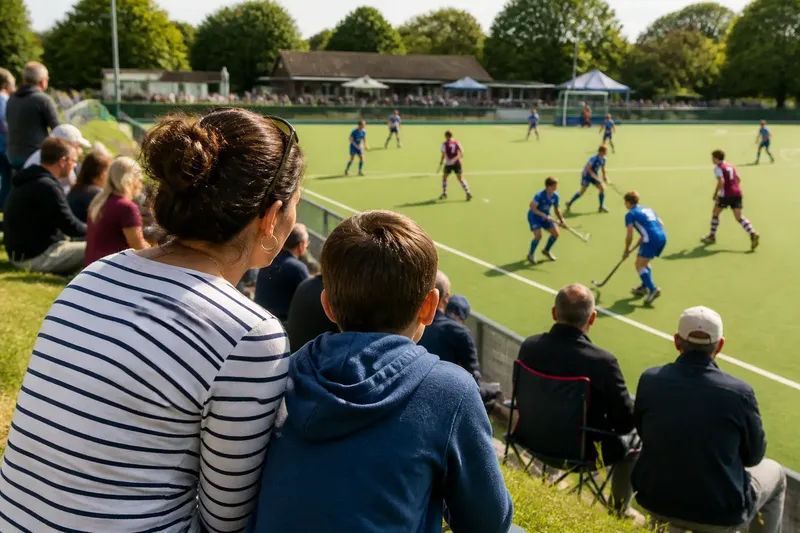
You reach the community pitch just as the players spread out, and the ball is already moving. At a first local match, you can follow the game without knowing every rule: pick one team and watch where its players go, when play stops and what changes afterwards.
That approach suits a casual spectator, a parent joining a group of regulars, or anyone who has been invited to a sport they do not follow. You are not trying to reconstruct every decision. You are looking for a few visible patterns that make the action easier to read.
Choose your starting point
Your best focus depends on what brought you to the match. Use the situation that sounds most like yours; you can shift your attention later if the first choice feels difficult.
- If you came with a friend: follow the team your friend supports. Their reactions will help you notice which moments matter to them, and you can ask a simple question during a natural pause.
- If you are watching a child or relative: follow that person’s movements, then look at the teammates nearest them. This makes the match personal without requiring you to understand every tactic or call.
- If both teams are unfamiliar: choose the side that begins nearest you, or the side wearing the colour you can distinguish most easily. Staying with one group gives your eyes a consistent reference.
- If the action feels too quick: watch a player who is not carrying or directly contesting the ball. Their movement often reveals where the team hopes to go next, and is easier to follow than a crowded challenge.
- If you would rather take in the occasion: notice the sideline, the bench and the way players respond to one another. Community sport includes greetings, encouragement and shared routines as well as the contest.
Choose one focus for a short stretch instead of trying to track the whole field at once. A steady viewpoint helps more than a running list of rules.
Track one team’s shape
“Shape” means the rough arrangement of players as their team has the ball, loses it or tries to win it back. You do not need the sport’s tactical vocabulary. Look for who stays close together, who spreads out and who moves towards the action.
Start by finding the player with the ball, puck or other object in play. Then glance at the nearby teammates: are they offering short options, moving into open space or holding their positions? When the other side takes possession, notice whether the group retreats, presses forward or reorganises around a central area.
Say you arrive at a local hockey match without knowing its rules and decide to follow the home side. You notice that a defender often moves forward after the ball reaches the wing; when the opposing team gains possession, that defender turns back and the nearby players close the space. You can now recognise a recurring change in the team’s shape without needing to name a formation.
Keep the observation modest. A player may be following a coach’s instruction, covering for a teammate or responding to an opponent; you do not have to decide which. Seeing a pattern is enough to make the next passage of play more legible.
Use pauses as markers
Stops in play offer natural points to reset your attention. The cause might be a boundary, a foul, an injury, a substitution or a scheduled break, depending on the sport. You can simply note what was happening just before the pause and where the players gather afterwards.
Watch for the restart’s visible routine. Someone may place the ball, step back, signal to a teammate or wait for an official. These small actions show that play is about to resume, even when you do not know the exact rule behind the stoppage.
A pause can also tell you where to look next. If players return to familiar positions, follow the team’s shape again; if a substitute enters, choose that player as your temporary reference. If the game is stopped for a player who needs attention, give space to those managing the situation rather than trying to interpret it from the sideline.
At a community match, spectators may be close enough to hear instructions or conversation. Treat those words as background, not an invitation to coach, question an official or interrupt a player. Follow any local guidance about where spectators may stand.
Read repeated patterns
Once you have a reference team, look for repetitions rather than isolated moments. Does the side often pass towards one area? Do several players move together when possession changes? Does the team slow down before a restart, or spread out when it has space?
Repeated actions help you form a simple account of the match: one side is trying to move the play wide; the other is gathering near the centre; a particular player keeps finding space. Treat these as observations, not verdicts. A team can change its approach, and a pattern may disappear as the players adapt.
When the ball moves out of view or a crowd gathers around it, do not strain to follow every touch. Find the players who are waiting for the next phase, then watch how they adjust as the action becomes clear. This is often calmer than switching your gaze rapidly between the ball and every player.
Imagine you are beside a relative at a village cricket match and have lost track of what an official call means. You notice the fielders move closer after a stretch of quiet play, then spread out again as the next delivery is prepared. Rather than guessing at the call, you can ask your relative what changed during the pause and return your attention to the field’s arrangement.
Which viewing approach fits?
Should I follow the ball or one player?
Follow the ball when you want the broad sequence of action and it remains easy to see. Follow one player when the game feels crowded or fast, because their movement can give you a steady point of reference.
What should I watch if I miss a stoppage?
Look at where players are gathering and what they do before play resumes. Their positions and preparation are usually more useful clues than trying to guess what happened from a distance.
How can I ask about a rule without interrupting?
Wait for a break in play and ask a companion one short question, such as, “What caused that restart?” If no one is available to explain, set the uncertainty aside and keep watching the visible action.
What if the crowd’s reactions confuse me?
Notice whether the reaction follows a score, a whistle, a close contest or a player’s effort, but do not assume that every cheer has the same meaning. A quiet moment may also reflect concentration rather than dissatisfaction.
Set a comfortable pace
You do not need to keep up with every exchange to enjoy the occasion. Look away briefly to check the programme, greet someone or get a drink, then rejoin by finding your chosen team or player. The next pause offers an easy point to start again.
If you want context, use a programme or ask a knowledgeable companion for one useful detail: how scoring works, what usually causes a restart, or which player to watch. A single answer can give the next passage of play a clearer shape; collecting explanations for every call is unnecessary.
At the end, you might remember a team’s habit of spreading out, a player’s movement or the way everyone gathered before a restart. That is enough to make a return visit easier. To follow a community match without knowing every rule, choose one visible thread and let the game show you what repeats.